Get a FREE Case Evaluation
"*" indicates required fields

Quick Facts
- Platforms Named: Facebook, Instagram, Snapchat, YouTube, TikTok
- Potential Injuries Caused by These Products: Depression, PTSD, self-harm, suicidal behavior, eating disorders, anxiety
- Parent Companies Listed in Lawsuits: Meta, Snap, Alphabet (Google), ByteDance (TikTok)
- Lawsuit Type: MDL
- Lawsuit Status: Bellwether trials underway
Youth Social Media Addiction & Mental Health Lawsuits
Individuals are filing lawsuits against Meta, Alphabet, Snap, and TikTok because of alleged social media addiction in children and its impacts on their mental health. Some youth and teens experience depression, eating disorders, self-harm, and suicidal behavior after consuming content on social media.
Parents and young people allege that platforms like Instagram, Facebook, YouTube, TikTok, and Snapchat have caused mental health injuries to children and teens and are specifically designed to be addictive and overused.
Some lawsuits filed by parents and young people have been centralized in the Northern District of California under MDL# 3047, which is named In Re: Social Media Adolescent Addiction/Personal Injury Products Liability Litigation. These cases have been filed in federal courts, meaning potential plaintiffs can come from anywhere in the U.S.
As of October 1, 2026, there are 3,824 lawsuits pending in the federal social media addiction MDL. The presiding judge is Yvonne Gonzalez Rogers. This lawsuit is in its early stages, with bellwether cases underway and additional cases scheduled for mid-2026. People are continuing to file social media addiction lawsuits today, with new cases regularly being added to the MDL.
Social Media Lawsuit Timeline & News – Month Year
September 25, 2026: Article Explores How States Might Use Meta Settlement Money
Fifty-one U.S. states and territories will receive money from the $16-billion-plus Meta settlement. How the money will be used varies by state, with some funds going toward youth mental health initiatives and others going into general funds. Learn more about how states might allocate their Meta settlement dollars in this LinkedIn post by Lawsuit Tracker litigation partner Robert King.
September 10, 2026: California Bans Addictive Social Media Features for Children
A new California law bans social media companies from allowing children under 16 to access certain addictive features, including autoplay and algorithm-driven feeds.
September 10, 2026: Texas Judge Finds Social Media Company Misled Consumers About Child Safety
A Texas judge granted Attorney General Ken Paxton’s motion for partial summary judgment, finding that a short-form video platform misled consumers about children’s exposure to graphic content. The case will proceed to trial over penalties and other relief.
September 4, 2026: Robert King Discusses Multi-Billion-Dollar Meta Settlement
Lawsuit Tracker partner attorney Robert King discusses the landmark social media settlement between Meta and multiple U.S. states and territories, including how settlement funds could be distributed and new protections Meta has agreed to implement for minors.
August 26, 2026: Meta Reaches Social Media Settlement Worth Up to $17.1 Billion
California’s Attorney General announced a settlement worth up to $17.1 billion between Meta and 51 state attorneys general. The settlement resolves many federal social media addiction and child privacy claims and requires changes intended to protect underage users. New Mexico and Florida did not join the settlement.
August 10, 2026: Appeals Court Dismisses Social Media Companies’ Appeals
A federal appeals court dismissed appeals involving Section 230 defenses claimed by social media companies. The court held that Section 230 can provide a defense from liability where applicable but does not provide blanket immunity from being sued.
August 6, 2026: Meta Ordered to Pay $567 Million to Teen Mental Health Fund
A New Mexico court ordered Meta to pay $567 million to a state teen mental health fund. The order also requires additional protections for children and teens using Meta’s platforms.
August 3, 2026: TikTok Settles Three Teen Social Media Addiction Lawsuits
TikTok reportedly settled lawsuits brought by three teens who alleged that addictive platform designs harmed their mental health. Meanwhile, the federal social media addiction MDL had grown to 3,137 lawsuits as of August 3.
July 27, 2026: Tennessee AG Says Meta Disregarded Internal Research
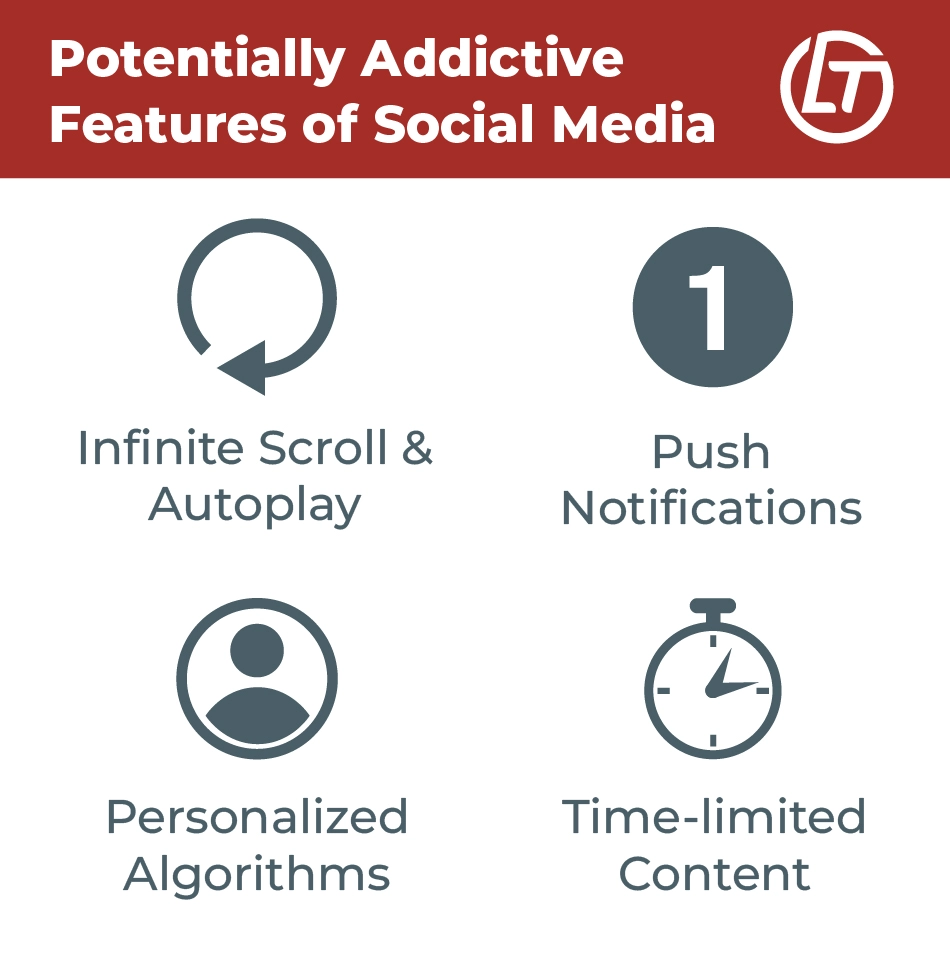
Tennessee’s Attorney General alleged that Meta failed to act on internal research indicating that features such as notifications, infinite scroll, and autoplay could encourage unhealthy or compulsive social media use among teens.
July 22, 2026: Teen Drops Bellwether Case Against Meta
A teen dropped his claims against Meta after reportedly receiving settlements from other social media companies. His lawsuit had been selected as a bellwether case in California’s social media litigation.
June 23, 2026: YouTube Settles Social Media Addiction Lawsuit with Teen
Google (YouTube) has settled with a teenage boy who alleged that social media design features contributed to his addiction. The terms have not been made public, and the case against the remaining defendants is scheduled for July 27, 2026.
June 15, 2026: U.K. Bans Social Media Accounts for Children Under 16
The U.K. will prohibit children under 16 from having accounts on major social media platforms beginning in spring 2027. The rules also include new restrictions on livestreaming and contact with strangers on gaming platforms.
June 10, 2026: Judge Denies Google and Meta’s Request for New Social Media Addiction Trial
Judge Kuhl denied Google and Meta’s request for a new trial following a jury verdict for the plaintiff. The judge cited “substantial evidence” that Instagram’s design features harmed the plaintiff independent of third-party content.
May 26, 2026: Supreme Court Rejects Meta Appeal in Vermont Social Media Case
The U.S. Supreme Court declined to hear Meta’s appeal seeking dismissal of a lawsuit brought by Vermont over alleged harms to children from Meta’s social media products. The lawsuit can now move forward.
May 21, 2026: Meta Settles School District Social Media Lawsuit
Meta settled a lawsuit brought by Kentucky’s Breathitt County School District, which alleged that its platforms contributed to student mental health and learning problems. The case was the first school district bellwether in the federal social media MDL, and the other defendants had already settled.
May 20, 2026: Surgeon General Releases Report on Harms of Screen and Social Media Use
The U.S. Surgeon General released a report titled “Surgeon General’s Warning on the Harms of Screen Use.” The report links harmful screen use, particularly social media use, with developmental, mental, physical, and educational challenges among children and teens.
May 15, 2026: YouTube, Snap, and TikTok Settle School District Lawsuit
YouTube, Snap, and TikTok settled claims brought by Kentucky’s Breathitt County School District. The district alleged that addictive platform designs harmed students’ mental health. The district sought compensation for resulting costs.
March 26, 2026: Jury Decides on Amount of Punitive Damages in Social Media Addiction Case
During the first bellwether trial in the social media MDL, Google and Meta were found liable for harming the mental health of a young woman who used social media as a minor. She has been awarded $6 million in her landmark social media lawsuit. The jury decided that punitive damages were warranted in the case and has decided on the amount of those damages. Now, Meta has been ordered to pay a combined $4.2 million in damages, and Google/YouTube has been ordered to pay $1.8 million. The $6 million verdict is the first of its kind. The case argued that social media companies were creating a product, a product that is defective and potentially harmful to children. The lawsuit also argued the companies knew of the potential dangers and chose to ignore internal warnings and data or protect minor users of its platforms.
March 25, 2026: Jury Awards Women $3M in Her Lawsuit Against Social Media Companies
A young woman who alleged her mental health conditions were the result of childhood social media addiction has been awarded $3 million by a federal jury in California. Meta, which owns Facebook and Instagram, and Google, which owns YouTube, have been ordered to pay 70% and 30% of that verdict, respectively. The woman filed a lawsuit alleging that social media addiction she experienced from a young age caused her to develop depression and anxiety. The jury found that Meta and Google had created addictive products and did not have the proper safeguards in place to protect her as a minor. The jury also decided that punitive damages are warranted, though that amount will be determined at a future date. This trial was the first bellwether trial in the social media addiction MDL, and the parties are expected to appeal.
March 24, 2026: New Mexico Jury Orders Meta to Pay $3.7 Million in Damages to the State
A jury in New Mexico has found Meta liable for misleading consumers about the risks of children using its social media platforms, thus endangering children. Meta has been ordered to pay the state $3.7 million. This lawsuit (State of New Mexico v. Meta Platforms, Inc.) was brought by the New Mexico Department of Justice. After hearing arguments, the jury sided with the plaintiffs and agreed that Meta was negligent in marketing its social media products to children without the proper warnings or safeguards in place. Meta is expected to appeal. New Mexico has also filed another lawsuit against Meta, claiming the company is a public nuisance and should change its social media platforms to better protect minor users.
February 18, 2026: Mark Zuckerberg Testifies in Social Media Addiction Lawsuit
Meta CEO Mark Zuckerberg testified in Los Angeles Superior Court as part of the first bellwether trial in the social media addiction MDL. The lawsuit was filed by a 20-year-old woman named KGM and filed against Meta, YouTube, Snap, and TikTok. Zuckerberg was questioned about internal communications, indicating that Instagram targeted tweens and children as young as 10 in violation of their own age limits. He was also asked to testify about internal Meta research indicating a major Instagram feature, beauty filters, caused body image issues in young girls. At the time, he ordered the company to keep the filters, saying that removing them would be “paternalistic.”
Zuckerberg defended his decision-making and argued several times that the plaintiff’s attorneys were taking things out of context or misrepresenting them. The trial, which will be decided by a jury, is expected to conclude by April.
February 10, 2026: First Social Media Addiction Test Trial Begins
After settlement agreements with Snap and TikTok, the first social media addiction bellwether trial has begun, with Meta and YouTube named as the remaining defendants. As part of the opening arguments, plaintiff’s lawyer Mark Lainier presented internal documents from both companies, which he argued showed they knew the dangers of their platforms, with Google employees calling their app a “casino” and Instagram employees likening themselves to drug pushers. The trial, one of three initial bellwether cases, is expected to last from 6 to 8 weeks.
January 27, 2026: TikTok Settles in K.G.M. Bellwether Case
TikTok became the second defendant to reach a settlement with K.G.M. prior to going to trial, with an agreement in principle announced just before jury selection. Terms of the settlement have not been disclosed. Meta and YouTube are still expected to stand trial.
January 20, 2026: Snap, Inc. is First Defendant to Settle in Social Media Addiction Bellwether Case
Snap, parent company of Snapchat, became the first defendant to settle in the pending social media addiction bellwether case brought by a 19-year-old California woman identified as K.G.M. The suit accuses Snap, TikTok, Meta, and YouTube of making their apps addictive on purpose and causing serious mental health side effects. Terms of the settlement were not disclosed. Snap cofounder and CEO Evan Spiegel will no longer need to testify at the trial.
October 6, 2022: Social Media Addiction Lawsuits Consolidated Into Federal MDL
Eighty-four lawsuits against social media companies were centralized into a federal MDL in the Northern District of California. The suits allege that Facebook, Instagram, YouTube, Snapchat, and TikTok used addictive design to hook children on their products, causing depression, eating disorders, and other serious psychiatric side effects. The cases were centralized in Federal Courts under U.S. District Judge Yvonne Gonzalez Rogers in the Northern District of California.
On this page:
Social Media Lawsuit Timeline & News – Month Year
What is the Social Media Addiction Lawsuit & Mental Health Lawsuit About?
Why Are People Filing Social Media Addiction Lawsuits?
Which Social Media Companies Are Named in Lawsuits?
Allegations Against Social Media Companies
What Stage is the Social Media Addiction Lawsuit In?
What Injuries Are Associated with Youth Social Media Addiction?
Studies Linking Social Media Usage to Addiction and Psychiatric Disorders
What Damages Can People Sue Social Media Companies For?
Who Qualifies to File a Social Media Addiction Lawsuit?
Steps to File a Social Media Addiction Lawsuit
What is the Deadline for Filing a Social Media Addiction Lawsuit?
Social Media Addiction Settlements and Awards
Learn More About Social Media Addiction Lawsuits From Our Legal Team
What is the Social Media Addiction Lawsuit & Mental Health Lawsuit About?
Parents and young people are filing lawsuits against social media companies, alleging that the companies have purposefully designed an addictive product that causes mental health harms in children and teens.
As countries around the world implement age limits and other legal limitations on social media usage in children, major social media platforms and their parent companies are facing lawsuits for allegedly causing addiction and related side effects in minor users. The lawsuits allege that apps like Instagram, TikTok, and YouTube are designed to be addictive, and that the companies that own them have negligently ignored evidence of their harmfulness to children.
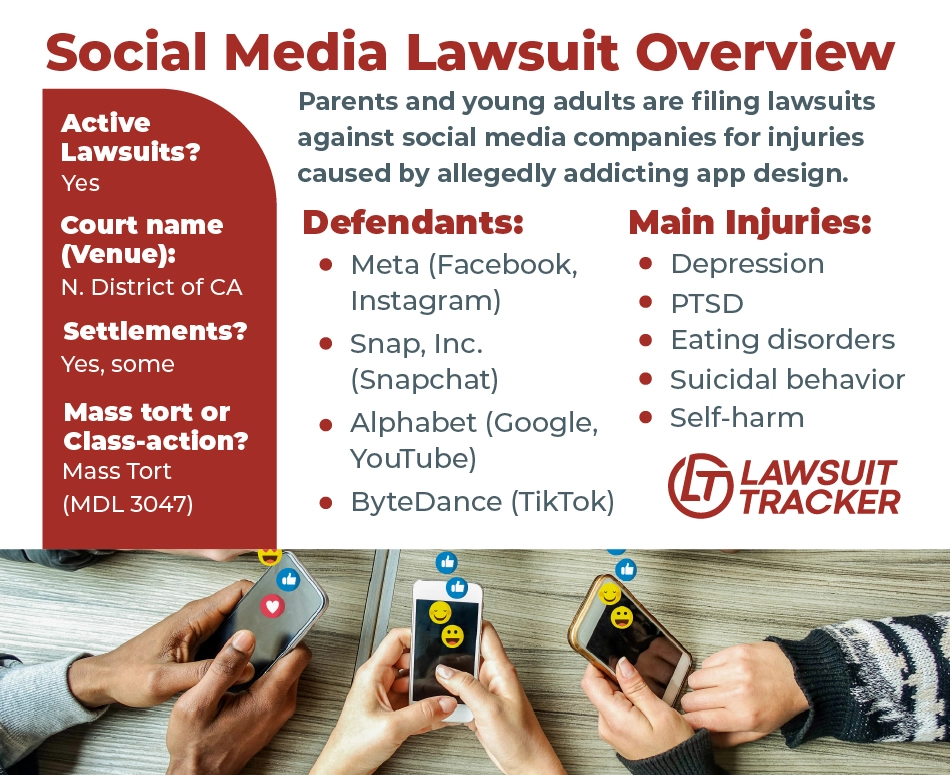
| Social Media Addiction Lawsuit Information | |
| Lawsuit Name: | In Re: Social Media Adolescent Addiction/Personal Injury Products Liability Litigation |
| Main Injuries: | Depression, eating disorders, anxiety, self-harm, suicidal ideation, and behavior |
| Defendants: | Meta (Facebook, Instagram), Alphabet/Google (YouTube), Snap Inc. (Snapchat), ByteDance (TikTok) |
| Mass tort or class action? | Multi-district litigation, with bellwether trials underway |
| MDL Number: | 3047 |
| Pending Cases: | Yes |
| Court Name (Venue): | Northern District of California |
| Have There Been Settlements? | Yes. Snap and TikTok have settled the first bellwether case before going to trial. |
| Active Lawsuit? | Yes |
Why Are People Filing Social Media Addiction Lawsuits?
Parents and young people are filing social media addiction lawsuits, alleging several wrongdoings by social media developers, including:
- Recruiting and targeting underage users to platforms
- Not instituting proper age-verification processes
- Designing apps to be addictive
- Promoting harmful content to minors
- Causing a variety of mental health conditions
- Concealing evidence of the apps’ harmfulness
In the first bellwether trial in the MDL, ByteDance (TikTok) and Snap, Inc. (Snapchat) have settled. Meta (Facebook, Instagram) and Alphabet/Google (YouTube) are ongoing. It remains to be seen if additional bellwether trials will proceed.
Meta and YouTube Bellwether Lawsuit Spotlight
K.G.M. vs Meta et al.
In a bellwether case tied to more than 2,400 other suits, Meta and YouTube are being sued by a 20-year-old California woman, identified in the suit by the initials K.G.M., who alleges a childhood addiction to social media led to depression, suicidal thoughts, and body-image issues.
The lawsuit accuses Meta of deliberately targeting users under its own age limit of 13. It accuses Meta of working to hook children on the app through features like beauty filters, infinite scroll, and autoplay while concealing evidence of potential harm from the public.
Evidence presented in the trial has included a number of internal Meta documents, including confirmation that Meta was aware that 30% of US 10-to-12-year-olds were on Instagram, and a strategy document that declared “if we want to win big with teens, we must bring them in as tweens.” (Zuckerberg has said this quote is being taken out of context.)
Other documentation shows that, when mental health experts hired by Meta confirmed that beauty filters led to body-image issues in users, Zuckerberg nonetheless elected to keep them.
Early testimony has focused on Meta, with evidence related to YouTube to come. This case is expected to run through March 2026 and will be decided by a Los Angeles jury. The verdict in this bellwether trial will have implications for the defendants and other plaintiffs in the MDL.
Which Social Media Companies Are Named in Lawsuits?
Defendants in the social media addiction lawsuit include the app companies and their parent companies:
- Meta, parent company of Facebook, Instagram, WhatsApp, and Messenger
- Alphabet, Inc, parent company of Google and YouTube
- Snap, Inc., parent company of Snapchat
- ByteDance, parent company of TikTok
Information for some of the defendants is listed below.
Defendant 1: TikTok (ByteDance)
ByteDance, based in China, is the parent company of TikTok, a short-form video social media app with 200 million users in the United States. TikTok algorithmically presents videos to users, and is frequently responsible for sparking viral trends.
In recent years, TikTok has come under increased scrutiny in the U.S. over concerns about Chinese government influence operations and access to user data. This led to local and institutional restrictions as well as a de facto national ban that was implemented in January 2025. After years of pressure from the U.S. government, in December 2025, it sold a majority stake in its U.S. TikTok business to a consortium of investors, including Oracle.
TikTok was named as a defendant in KGM’s bellwether case but settled prior to going to trial.
Defendant 2: Snapchat (Snap, Inc.)
Snapchat is a popular photo-sharing app. A distinguishing feature is that most messages can only be viewed for a limited time. As its user base has grown above 300 million, it has expanded beyond messaging to include algorithmic content feeds similar to other leading social media platforms.
In the bellwether lawsuit brought by K.G.M., Snap was named as a defendant but, like TikTok, settled before trial. Snap CEO Evan Spiegel will no longer need to testify in that case.
Defendant 3: Instagram & Facebook (Meta)
Meta is the parent company of Facebook and Instagram, which it acquired in 2012. Facebook launched in the early 2000s as a pioneering social networking platform, while Instagram started as a photo-sharing app before eventually adding video sharing features similar to TikTok. As of the end of 2025, Meta reported 3.58 billion daily active users across its family of applications, which includes Facebook, Instagram, WhatsApp, and Messenger.
In 2021, Facebook, Inc. employee Frances Haugen leaked thousands of pages of internal research and documents and testified before Congress as a whistleblower. Haugen testified that the company knew its platform was harmful, and said that it “harm[s] children, stoke[s] division and weaken[s] our democracy.” (Facebook, Inc. rebranded to Meta in late 2021.)
Defendant 4: YouTube (Alphabet/Google)
YouTube is a video creation and sharing platform owned by Alphabet, the parent company of Google. It provides both short- and long-form videos. Similar to other platforms, YouTube algorithmically suggests content to users to create a personalized experience. Like other platforms, its revenue comes primarily from advertisements, and therefore has a strong financial incentive to increase viewership.
One mixed-method study of 106 subjects found an almost 40% rate of severe YouTube addiction.
Allegations Against Social Media Companies
The lawsuits allege that the makers of social media platforms, including Instagram, Snapchat, YouTube, and TikTok, have caused addiction in youth, resulting in mental health injuries. Plaintiffs allege their social media addiction caused depression, body image issues, suicidal thoughts, and other psychiatric disorders. Moreover, they accuse the defendants of deliberately designing their apps to be addictive and, in some cases, targeting children against their own age limits for usage.
Social media companies have argued that they are exempt from liability under Section 230 of the Telecommunications Act of 1996, which says that interactive computer services are not liable for content users create on them. Courts have frequently interpreted this statute in favor of platforms. Because the social media addiction lawsuits have focused on platform design rather than specific content, the courts have so far ruled that Section 230 does not definitively apply, and have allowed the cases to move forward.
What Stage is the Social Media Addiction Lawsuit In?
An early bellwether trial against Meta and Alphabet is in progress as of March 2026. It is expected to last through the end of March. TikTok and Snap, Inc. were also named as defendants in the suit, but settled before going to trial. This bellwether case is tied to more than 2,400 additional lawsuits. Its result will have profound implications for those suits, as well as other future cases.
Other suits are also ongoing. A federal bellwether case on behalf of school districts is set to begin in June 2026 in California. Attorneys General in more than 40 states have sued Meta for similar claims of addiction and harm to children.
What Injuries Are Associated with Youth Social Media Addiction?
Youth social media addiction is associated with a variety of serious, sometimes interrelated psychiatric disorders, including:
Self-harm (Nonsuicidal Self-Injury Disorder)
Self-harm without suicidal intent, such as purposefully cutting or burning oneself, can have many causes, including trauma, depression, anxiety, eating disorders, and strong feelings of isolation.
People who self-harm may do so to manage difficult feelings, to feel a sense of control, or to broadcast their distress to others. Self-harm can cause scarring and other lasting physical damage, as well as serious complications such as infection. It can be difficult to diagnose because people typically try to keep it a secret.
Depression
About 20% of teens have been diagnosed with depression, which refers to persistent feelings of sadness that last for two weeks or more, along with feelings such as hopelessness, irritability, and low self-esteem. Studies have indicated a direct link between social media usage and depression.
Depression can cause difficulty sleeping, loss of appetite, loss of enjoyment in things like hobbies or school, and may lead to self-harm, eating disorders, substance abuse, or suicidal ideation.
Anxiety
Anxiety is common in children, present in up to 20% of adolescents and a third of teens ages 13 to 18. It can present in different ways, including social anxiety and specific phobias. Children with severe anxiety may experience panic attacks, a physical reaction to fear that may involve difficulty breathing, sweating, and a racing heart.
Eating disorders
Eating disorders, including anorexia nervosa, bulimia nervosa, and binge-eating disorder, are a group of mental health disorders that affect a person’s relationship with food and their eating habits. More than 1 in 5 children and adolescents globally has an eating disorder.
Eating disorders are often associated with body-image issues and depression. They may be characterized by behaviors like bingeing and purging, self-starvation, or excessive exercise. They can cause physical side effects like fatigue, loss of energy, weight fluctuations, thinning hair, and can even be fatal. Evidence suggests that eating disorders are a leading cause of death among mental illnesses.
Suicidal ideation and behavior
All of the above are risk factors for suicide and suicidal ideation, a leading cause of death among United States youth. It has seen an increase in prevalence that closely correlates with the increase in social media use and popularity.
Signs and Symptoms of Social Media Addiction and Compulsive App Use
Someone with a social media addiction may exhibit the following behaviors:
- Excessive screen time
- A compulsion to check their device and social media accounts
- Declining school or work performance
- Erosion of real-world relationships with friends and family
Studies Linking Social Media Usage to Addiction and Psychiatric Disorders
As child social media usage has exploded alongside rising rates of mental health conditions such as depression and anxiety, a number of studies have examined the relationship between the two.
Studies have generally found a correlation between social media usage and conditions such as depression, anxiety, and eating disorders. While many of these studies stop short of saying social media usage causes these conditions, there is a growing body of research showing a causal relationship.
Important Article: Social Media Algorithms and Teen Addiction: Neurophysiological Impact and Ethical Considerations
Drawing on dozens of prior studies and articles, this article in Cureus lays out the mechanisms by which social media usage can lead to addiction. It argues that social media usage (including likes, comments, and other features) stimulates the brain’s dopamine reward centers just as physical addictions do.
When combined with algorithmic feeds designed to keep users engaged with an app, this creates an addictive feedback loop that teens and adolescents are particularly vulnerable to. The article goes on to highlight ethical concerns around this addictive potential.
| Overview: Social Media Algorithms and Teen Addiction: Neurophysiological Impact and Ethical Considerations | |
| Description of Article: | This article examines how the brain responds to extended social media use |
| Published In: | Cureus |
| Study Authors | De, Debasmita, , Mazen El Jamal, Eda Aydemir, Anika Khera |
| Findings | Social media usage stimulates the brain’s reward centersThis effect is enhanced by algorithmically provided content, leading to an addictive feedback loop |
Important Study: Social Media Use and Depressive Symptoms During Early Adolescence
This study, published in JAMA Network Open in 2025, examined social media usage and depression in a cohort of nearly 12,000 adolescents aged 9-10 and then the same group aged 12 to 13. As one of the first studies of this type to examine the link between social media and depression, it was able to assess changes over time and draw causal conclusions that previous studies were unable to.
The study found that increased social media usage led to a higher risk of developing depression over time. An average daily usage increase of 7 to 73 minutes led to a 35% increase in depression symptoms. Notably, an increase in depressive symptoms did not lead to an increase in social media usage.
| Overview: Social Media Use and Depressive Symptoms During Early Adolescence | |
| Description of Study: | A cohort study examining the relationship between adolescent social media usage and depression symptoms over time |
| Published In: | JAMA Network Open |
| Study Authors | Jason M. Nagata, MD; Christopher D. Otmar, PhD; Joan Shim, MPH et al. |
| # of Participants | 11 876 children and adolescents |
| Findings | Social media usage at a young age increases risk of depressive symptoms |
What Damages Can People Sue Social Media Companies For?
Individuals suing social media companies for addiction and its consequences may be eligible for damages and compensation in a number of areas. (This will depend on the outcome of bellwether trials, as well as the specifics of individual cases.)
- Medical Expenses:
- You may receive compensation for hospitalization, psychiatric care, medication, and other treatments. Compensation could be for expenses already incurred as well as expected future expenses.
- Pain and Suffering:
- Emotional Distress: The anxiety, depression, or other psychological trauma that developed from a social media addiction may lead to additional damages.
- Physical Pain: Lasting physical consequences (for example, due to an eating disorder or an attempt at self-harm) may lead to compensation.
- Loss of Quality of Life:
- Compensation for diminished ability to perform daily activities, hobbies, or enjoy life, all common side effects of depression and other psychiatric disorders alleged to be caused by social media addiction.
- Permanent Disability or Disfigurement:
- Conditions like depression, self-harming behavior, and eating disorders can have severe and lasting consequences, for which you may be compensated.
- Lost Wages:
- If you lost income due to your social media addiction, or have had your ability to work in the future affected, you may be eligible for compensation.
- Punitive Damages:
- The lawsuits allege that social media companies purposefully design their platforms to be addictive, and that some of them ignored experts who said their platforms were harmful. If the courts agree with these claims, punitive damages are more likely.
- Wrongful Death (if applicable):
- Some individual social media lawsuits have been filed on behalf of deceased individuals who committed suicide or died while attempting a viral social media challenge. Families of these individuals may be eligible for additional compensation for funeral costs and emotional distress.
- Legal Fees and Costs:
- You may recover litigation costs, including attorney fees and court expenses. You will typically only owe your attorney a fee if you win your case and receive compensation.
Who Qualifies to File a Social Media Addiction Lawsuit?
In order to file a social media addiction lawsuit, each person has to meet certain eligibility requirements. Our legal partners are focusing on the specific injuries listed below, incurred by individuals under 21 who used social media apps as minors:
- Suicidality
- Self-harmful behavior
- Depression
- Anxiety
- PTSD
- Eating disorders
Lawsuit eligibility may change throughout the course of the litigation. Contact our team to discuss your specific case and possible legal options.
What Proof Do You Need to File a Social Media Addiction Lawsuit?
To file a lawsuit, you’ll need to assemble documentation to make your case, a process your attorney will assist with. Broadly speaking, you need evidence to support the following:
- A diagnosis of depression, anxiety, or an eating disorder, and/or instances of self-harm or suicidal ideation
- A pattern and timeline of social media usage leading to that diagnosis
- The impact that social media addiction and its symptoms had on your life
- The financial cost of your addiction
Evidence and Timeline of Social Media Usage
- Social media usage data:
- You’ll need to include as much data as possible on your social media usage over time. Information like the time of usage will likely be available on your phone. You may be able to obtain other usage data directly from the social media company.
- Timeline:
- You’ll need to show a clear timeline of events, with a formal diagnosis happening after excessive social media usage.
Evidence About Your Diagnosis and Treatments
- Medical Records:
- Proof of diagnosis of one or more conditions, such as depression, anxiety, or an eating disorder
- Hospitalizations or doctor and specialist appointments
- Treatment Records:
- You’ll need to include records of related prescriptions, talk therapy, cognitive behavioral therapy, and treatment for self-harm or the physical effects of an eating disorder, and anything else related to a social media addiction or its consequences.
Evidence Showing Losses
- Proof of Damages:
- Impact on Quality of Life
- It’s important to demonstrate how a social media addiction has affected quality of life (through loss of enjoyment of hobbies or the physical side effects of an eating disorder, for example).
- Report cards, notes from teachers or guidance counselors, or other materials showing a decline in school performance over time
- Notes from therapy or counseling sessions
- Financial Records
- Medical bills, proof of lost wages, receipts for out-of-pocket expenses such as travel to see a specialist, and other expenses related to a social media addiction and its consequences.
- Pay stubs to indicate a loss of income (if applicable)
- Impact on Quality of Life
Testimony From You and Your Family
- Personal Testimony: The plaintiff will need to testify and answer questions about their social media addiction and its consequences. This can be emotionally difficult, but an experienced attorney will be able to support and guide you through the process.
- Witness Testimony: Parents, siblings, or extended family and/or friends will need to testify to the effects of the plaintiff’s social media addiction. This is especially important and powerful in cases involving minors.
Steps to File a Social Media Addiction Lawsuit
These are the general steps for filing a social media addiction lawsuit. Depending on the outcome of bellwether trials, several of these may not be necessary because a global settlement deal could be reached. Similarly, there may not be settlements in these lawsuits.
Here are the steps to filing a social media mental health claim:
- Consult an Attorney Specializing in Product Liability:
- An experienced attorney will review your injuries and experience with social media addiction to determine your eligibility to file a suit.
- Gather Relevant Medical Documentation:
- You’ll need as much evidence as possible to support your case. This will include your social media usage history, relevant medical records (for example, a diagnosis of depression or an eating disorder), doctors’ notes, and other records.
- File the Lawsuit in Court:
- Your attorney will file your lawsuit within the statute of limitations. If eligible, your case will likely be added to the social media addiction MDL.
- Pre-Trial Discovery:
- Before going to trial, both sides will work to gather evidence and testimony to support their case. In an MDL, discovery happens before bellwether trials, so most plaintiffs do not need to participate in all aspects of discovery.
- Settlement Negotiations:
- A settlement may be the best outcome for both sides, removing the risk of losing a trial. Companies also may opt to settle to avoid admitting fault or testifying under oath. Your attorney will negotiate this for you.
- Trial (If Necessary):
- If a settlement is not reached, your case may go to trial.
- Receive Compensation:
- This will depend heavily on the outcome of the bellwether trials. Potential compensation includes damages for pain and suffering, punitive damages, and reimbursement for medical bills and legal fees.
What to Expect When Filing a Social Media Addiction Lawsuit
The most important thing to know about filing a lawsuit is that your attorney will guide you through the process at every step. The length of the process may vary–while many of the cases in the MDL were filed as far back as 2022, settlements or a ruling in the bellwether cases may speed the process up significantly. Compensation will depend on the outcome of these trials, as well as the severity and specific details of your case. Typically, you will only pay legal fees to your attorney if you win your case.
What is the Deadline for Filing a Social Media Addiction Lawsuit?
In order to file a lawsuit, you must do so within the statute of limitations. This varies from state to state but is usually between 1 and 3 years from either the date of injury or the discovery that an injury was linked to product liability. In some states, the statute of limitations is as long as 6 years. (Your state’s statute of limitations may also be longer when a case involves a minor. Sometimes the state-by-state deadline is different for wrongful death claims.)
It is recommended that you start gathering documentation and consult an attorney as soon as possible if you think you may have a case. Even if you are not sure, an experienced attorney can help determine whether you might be eligible for a lawsuit and, if so, help you file within the time limit.
Social Media Addiction Settlements and Awards
It is still early in the bellwether trial process. Throughout 2026, social media companies have settled with 51 state attorneys general and territories. The August 2026 settlement could result in more than $16.8 billion distributed among the 51 plaintiffs. However, this money will not go to individuals who have filed mental health lawsuits.
In March 2026, a jury ordered YouTube and Meta to pay a 20-year-old woman, known as K.G.M., a combined $6 million. The jury said that YouTube and Instagram were partially responsible for mental health harms experienced by K.G.M., who started using the platforms as a minor.
Some state attorneys general have settled with social media companies outside of the landmark $16.8 million settlement. For example, in September 2025, the Arkansas attorney general negotiated a landmark settlement with TikTok over youth mental health harms. Alabama will receive $100 to $300 million in this settlement.
As social media companies continue to settle with states, it could put pressure on some companies to settle with individual plaintiffs.
Average Settlement Amounts
Average settlements in social media lawsuits will vary greatly depending on the plaintiff, the harms, and a variety of other factors. Individual social media settlements could range from $25,000 to $100,000 or more. Settlements with state attorneys general and school districts will likely be worth many millions of dollars.
Factors Affecting the Value of a Social Media Addiction Lawsuit
The outcome of the bellwether trials will make the value of potential compensation in this suit much clearer. Factors that will likely play a role include:
- Injury Severity: Generally speaking, the more severe an injury, the higher the compensation.
- Some suits against social media companies involve wrongful death. These may be eligible for higher compensation.
- Impact on Life: Many people with social media addictions experience significant impact on their quality of life, including poor school performance, erosion of social and family relationships, and more. The degree of impact may influence compensation.
- Punitive Damages: If the companies are found to have deliberately designed their apps to be addictive, and/or targeted children on purpose (as Meta is accused of doing), they may be liable for punitive damages.
Learn More About Social Media Addiction Lawsuits From Our Legal Team
If you believe you or a family member has been harmed due to a social media addiction, our experienced legal partners are standing by to help you. They can assist with every step of the process, from evaluating your case to navigating the lawsuit process. Contact them now for a free, confidential case review.
Get a FREE Case Review
Contact Us TodayYes. While there is not a consistent definition of social media addiction, studies have shown that social media usage stimulates the release of dopamine in the same way as other addictive behaviors and substances.
Behaviors like compulsively checking a device and excessive screen time, symptoms of depression, anxiety, or other mood disorders, declining performance at school or work, or deteriorating personal relationships may all be present in someone with a social media addiction.
This will depend on the specifics of your case and the outcome of the bellwether cases currently making their way through the courts. Speaking to an experienced attorney can help you understand what you may be entitled to. Compensation is never guaranteed.
There is not a class action lawsuit for addiction harms alleged against social media companies. However, there is a multidistrict litigation (MDL), which people can talk to a lawyer about filing for.
Yes. There are active civil lawsuits filed by parents of minors and young adults against social media companies. These lawsuits allege that companies made and marketed an addictive product to children.
If you became addicted to social media and injured as a minor, you may still be able to file a lawsuit against a social media company. A lawyer can help you determine if you have a viable case.
If you file a social media lawsuit, it is likely that “emotional distress” will be one of the injuries you claim. The amount you receive in a potential settlement will vary widely, depending on multiple factors (and no settlement is guaranteed).
There is no guaranteed payout in a social media lawsuit. If a plaintiff is awarded compensation, it will be based on their individual injuries and a number of external and internal factors.
If lawyers can prove that social media companies purposefully made products that it knew would harm children, these companies could be held liable in civil courts.
Contact Us Today
"*" indicates required fields